CURRENT ADVOCACY EFFORTS
On this page, you will find a sampling of some of the current advocacy efforts that Three Rivers Waterkeeper is involved to fight for clean water plus recent and historical clean water wins! As your Pittsburgh-based Waterkeeper we work to hold polluters accountable to secure clean water for our future generations.
Recent Community Wins

Sewer Line Break in Pine Creek Identified
During the summer, Three Rivers Waterkeeper samples popular recreation sites along our rivers for E. coli. Baseline sampling like this helps us understand what our waterways typically look like, allowing us to hone in on hot spots of high E. coli levels. This sampling helped us identify a broken sewer line in Pine Creek, which was contributing to recurring high E. coli colony levels downstream.


West Elizabeth Sanitary Authority Receives Deficiency Letter on Permit Renewal
In November 2025, Three Rivers Waterkeeper submitted comments to the PA Department of Environmental Protection regarding concerns over West Elizabeth Sanitary Authority (WESA)’s permit application to renew their Major Sewage Facility permit. WESA discharges in the Monongahela River in West Elizabeth (Allegheny County).

Gavco Materials Inc. Water Discharge Permit Withdrawn Due To Discharge of Hexavalent Chromium
In February 2024, Three Rivers Waterkeeper was notified by the PA DEP that Gavco Materials Inc. had withdrawn its wastewater permit. This comes after Three Rivers Waterkeeper and community members advocated for the PA DEP to deny this permit due to exceedances of hexavalent chromium, a known carcinogen, into a tributary that eventually flows into the Monongahela River.

Three Rivers Waterkeeper & PennEnvironment Settle Plastic Pollution Lawsuit Against Styropek
Three Rivers Waterkeeper and Penn Environment announced the settlement of their lawsuit against BVPV Styrenics LLC and its parent company, Styropek USA, Inc. The suit alleged violations of the federal Clean Water Act at Styropek’s plastic manufacturing facility in Monaca, Pennsylvania. The proposed settlement addresses the discharge of wastewater and stormwater containing the microplastics — in this case, tiny plastic pellets called “nurdles”— which are manufactured at the plant.

PA DEP Holds Washington Penn Plastics Accountable for Plastic Pollution in Washington County
In 2023, Three Rivers Waterkeeper submitted a complaint to the PA DEP based on community reports and our observations along Chartiers Creek, urging the PA DEP to further investigate this facility and take action against the plastic pollution. During inspections, DEP observed piles of plastic pellets on the ground and deposited along streambeds during multiple visits at multiple Washington Penn Plastics facilities.
Current Advocacy Efforts

Three Rivers Waterkeeper has sent a formal notice of intent to sue US Steel, Irvin Works Plant, for alleged violations of the PA Clean Streams Law for intermittent discharges of oily sheen on the Monongahela River emanating from the Irvin Plant on at least 36 occasions since December 2021.
Three Rivers Waterkeeper, with the support of community reports, has observed at least 36 occasions of oily sheen ranging from 2-18 miles long on the Monongahela River since December 2021.
Three Rivers Waterkeeper is represented by Appalachian Mountain Advocates.

On August 14, 2025, Three Rivers Waterkeeper filed a formal notice of appeal to the Pennsylvania Environmental Hearing Board objecting to the Pennsylvania Department of Environmental Protection’s issuance of National Pollutant Discharge Eliminations System (“NPDES”) Permit No. PA0091227 to the Calgon Carbon Corporation (Calgon).
The facility is located on Neville Island in Allegheny County and handles both hazardous waste under the Resource Conservation and Recovery Act (RCRA) and nonhazardous materials. This waste includes spent carbon that has been used to remove organic chemicals and other contaminants such as PFAS. PFAS are toxic to humans, animal life, and the broader ecosystems within which they live. Because PFAS are resistant to biodegradation, they persist and bioaccumulate in the body for many years after digestion, which is why they are often referred to as “forever chemicals.” Exposure to PFAS increases the risk of certain cancers, including prostate, kidney, and testicular cancer, and may produce a variety of adverse reproductive, developmental, or hormonal effects.
In the spring of 2025, Three Rivers Waterkeeper documented PFAS in wastewater coming from three Calgon’s outfalls and found 24 kinds of PFAS being discharged, total PFAS concentrations of 252.1 ppt, 209.6 ppt, and 360.6 ppt. The most prominent kind of PFAS was HFPO-DA, one of the GenX chemicals used by the Chemours Company, a facility that Calgon accepts materials, which the Waterkeeper recorded at 167.3 ppt in one outfall. Because of the known PFAS discharges, Three Rivers Waterkeeper is advocating for setting actual PFAS discharge limitations at Calgon.

Three Rivers Waterkeeper and Upper Chartiers Creek Watershed Association announced on Monday July 20, 2026, that they sent a formal notice of intent to sue Pennsylvania Transformer Technology, LLC for alleged violations of the federal Clean Water Act and Pennsylvania’s Clean Streams Law for multiple discharges polychlorinated biphenyls (PCBs) that exceed permit limits. Three Rivers Waterkeeper and Upper Chartiers Creek Watershed Association are represented by Appalachian Mountain Advocates.
Discharge monitoring reports submitted by Pennsylvania Transformer Technology, LLC to the Pennsylvania Department of Environmental Protection between March 2021 and the present show that Pennsylvania Transformer Technology has repeatedly violated and continues to violate numerous numeric effluent limitations, analytical standards, and monitoring and reporting requirements applicable to discharges from multiple outfalls, directly impacting Chartiers Creek in the Upper Ohio Watershed. The Creek is listed as impaired for aquatic life and fish consumption by Pennsylvania’s Department of Environmental Protection, which has identified PCBs as a source of impairment.
PCBs are a group of man-made organic chemicals consisting of carbon, hydrogen, and chlorine. Because of their chemical stability, heat resistance, and excellent electrical insulating properties, they were widely used in industrial and commercial applications like electrical transformers, coolants, and hydraulic fluids. They do not readily break down and accumulate in the food chain, and exposure is linked to cancer, as well as immune, reproductive, and nervous system damage. Commercial manufacturing and importation of PCBs were banned in the U.S. by the US EPA in 1979. Globally, they are heavily restricted by the Stockholm Convention on POPs.
“These toxic chemicals are being discharged into Chartiers Creek at exceptionally high levels and then flows into the Ohio River which provides drinking water to 5 million people, a recreational source for many, and critical habitat for a variety of plants and animals. We want to stop this ongoing harm as quick as possible and protect our communities and aquatic ecosystems from a toxic contaminate” states Dr. Heather Hulton VanTassel, Executive Director, Three Rivers Waterkeeper.
This notice is based on publicly available information, including discharge monitoring reports submitted by Pennsylvania Transformer. Relying on those reports and other related documents, Three Rivers Waterkeeper and Upper Chartiers Creek Watershed Association have identified numerous apparent violations of the Permit and applicable provisions of the Clean Water Act and the Clean Streams Law. The purpose of this notice is to identify those apparent violations and to provide an opportunity for these issues to be addressed during the statutory notice period.
"We work to restore and protect Chartiers Creek and believe no one should have to worry about toxic chemicals threatening the health of this watershed, or the people who live, work, and recreate along it," said Virginia McAnulty, President of the Upper Chartiers Creek Watershed Association. "We hope this action results in lasting protections so future generations can enjoy a cleaner, healthier creek and the many benefits it provides to our communities."
Chartiers Creek flows north and east from the center of Washington County into the center of Allegheny County. It discharges into the Ohio River at McKees Rocks, PA. The upper portion of the watershed in Washington County is not considered to be a navigable waterway of the United States. The size of the Upper Chartiers Creek Watershed is approximately 139 square miles. It is the most developed of the watersheds in the County, yet agriculture is still a major land use activity. While Chartiers Creek Watershed had an abundance of rich natural resources, decades of use, abuse, and development have degraded the environment and impaired Chartiers Creek. Nevertheless, hope remains high for the future of Chartiers Creek. Three Rivers Waterkeeper and Upper Chartiers Creek Watershed Association want this notice letter to lead to the protection of a highly used creek from future harm of a highly toxic chemical.
*****
Three Rivers Waterkeeper, a member organization of the Waterkeeper Alliance, has a mission to improve and protect the water quality of the Allegheny, Monongahela, and Ohio Rivers, which are critical to the health, vitality, and economic prosperity of our region and communities.
The Upper Chartiers Creek Watershed Association (UCCWA) is a group of volunteers who work to ensure the high environmental quality of the upper portion of Chartiers Creek – the portion located in Washington County, Pennsylvania. The lower portion of Chartiers Creek is located in Allegheny County.
Three Rivers Waterkeeper and Upper Chartiers Creek Watershed Association are represented by Appalachian Mountain Advocates, a public interest law and policy organization dedicated to fighting for people, clean water, clean air, and a responsible energy future. They use law and science to protect our region’s communities, land, forests, air, and water.

Three Rivers Waterkeeper has sent a formal notice of intent to sue Neville Chemical Company to stop intermittent discharges from its Neville Island Plant. The facility’s own self-reporting data documents consistent violations of their water discharge permit and the Clean Water Act.
These discharge violations include:
Hydrocarbons (such as Benzene)These organic compounds are made from hydrogen and carbon and often used as sources of energy. Excess hydrocarbons can degrade the environment and negatively impact the health of living things.
pHThis measures the acidity or alkalinity of the water being discharged into our rivers. A pH below 6.5 or above 8.5 is not conducive to life as it can cause damage to fish membranes or gills and increase the toxicity of metals to plants and animals.
Total Suspended SolidsThese suspended organic and inorganic particles can increase turbidity in the water and reduce the amount of sunlight that is able to pass through— leading to a loss of plant life in waterways.
Oil and GreaseThis form of pollution can form a film over the surface of the water and block sunlight and oxygen from passing through— leading to the loss of plants and other aquatic life.
Based on the company’s self-reported data, Three Rivers Waterkeeper and Appalachian Mountain Advocates counted that Neville Chemical is liable for as many as 9494 days of violations since July 2021.

On August 27, 2025, we sent a formal notice of intent to sue multiple entities for alleged violations of the PA Clean Streams Law at a heavily polluted site fronting the Allegheny River near 57th Street in Pittsburgh's Lawrenceville neighborhood. This site has historically been involved in refining and storing oil since the late 1800s, and there have been massive petrochemical losses and a huge tank fire on the site.
Three Rivers Waterkeeper is represented by Appalachian Mountain Advocates and alleges the site routinely discharges petrochemicals into the Allegheny River from multiple sources along the riverfrontage—a violation of the PA Clean Streams Law.

PITTSBURGH – On August 24, 2026, Three Rivers Waterkeeper filed a formal notice of intent to sue Harwick Operating Co. LLC (“Harwick”) for violating the Clean Water Act (CWA) at its site in Springdale Borough, Allegheny County, Pennsylvania, known as the Monarch Mine Dewatering Plant and the adjacent Cheswick Ash Disposal Site.
Harwick discharges stormwater, treated mine water and landfill leachate from a coal ash landfill into Little Deer Creek which flows into Deer Creek approximately 2.2 miles upstream of the confluence of Deer Creek and the Allegheny River. Discharge monitoring reports submitted by Harwick to the Pennsylvania Department of Environmental Protection (PADEP) show that from March 2025 to the present, Harwick has repeatedly violated its permit limits for iron, copper, cadmium, aluminum, manganese, total suspended solids, and hexavalent chromium. PADEP has listed Little Deer Creek under the CWA as impaired due to high levels of iron, aluminum, and manganese.
“Given its proximity to major drinking water sources, it is crucial that this facility complies with the Clean Water Act,” stated Dr. Heather Hulton VanTassel, Executive Director, Three Rivers Waterkeeper. The Oakmont Borough Municipal Authority and the Wilkinsburg-Penn Joint Water Authority have public drinking water intakes 3.5 and 10 river miles, respectively, downstream from Harwick’s site.
The notice is based on publicly available information, including Harwick’s CWA discharge permit and the discharge monitoring reports required by that permit. The purpose of the notice is to identify those violations and to give Harwick 60 days to achieve full comply before a citizen suit is filed.
"Our goal is to stop this ongoing pollution and protect our most critical natural resource - clean water;" said Dr. Hulton VanTassel. "We can’t continue to allow our streams and rivers that provide drinking water and critical habitat to plants and animals to be unnecessarily contaminated by toxic chemicals."
“This case shows the lingering long-term effects of burning coal to generate electricity,” said Jim Hecker, Senior Environmental Enforcement Attorney at Public Justice in Washington, D.C. “Even though the Cheswick power plant that burned the coal and generated the coal ash in the landfill has been shut down, pollutants from the coal mines and coal ash near the plant site are continuing to pollute the environment.”
Harwick is a wholly-owned subsidiary of Charah Solutions, Inc., a holding company which provides services to the power generation industry. Three Rivers Waterkeeper is represented by Public Justice and Steve Harvey LLC in Philadelphia, PA.
*****
Three Rivers Waterkeeper, a member organization of the Waterkeeper Alliance, has a mission to improve and protect the water quality of the Allegheny, Monongahela, and Ohio Rivers, which are critical to the health, vitality, and economic prosperity of our region and communities. For more information about our work, visit www.threeriverswaterkeeper.org.
Three Rivers Waterkeeper is represented by Public Justice. Public Justice fights for civil rights, consumer protection, environmental justice, and corporate accountability in courts across the country and the Supreme Court. For more information, visit https://www.publicjustice.net/.
From the Archives
Advocating for Railroad Safety
In 2015, we participated in a national Waterkeepers’ effort to document the structural integrity of 250 railway bridges that cross our rivers. Our inspection of the Fort Wayne Railroad Bridge was featured in the resulting national report, "Deadly Crossing". Currently, we monitor two major derailments in our region and serve as the communities’ watchdog. We continue to advocate for railway safety and transportation transparency.
On May 26, 2022, 18 train cars derailed on a small bridge outside Pittsburgh and spilled roughly 5,000 gallons of petroleum distillates into our rivers. We are working to increase transparency and information reporting to the public during major incidents that impact our drinking water sources. February 3, 2023, a Norfolk Southern freight train derailed in East Palestine, Ohio, about a quarter-mile west of the Ohio-Pennsylvania state line. The train was carrying 150 cars, and 50 cars were impacted by the accident. We are monitoring Sulphur Run and advocating for increased transparency and open accountability.


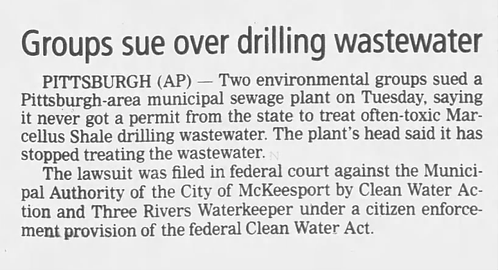
Three Rivers Waterkeeper & Clean Water Action Stop Illegal Dumping of Fracking Waste into the Monongahela River!